Marvels of the Month

Surrey History Centre is well known as a repository of information and documents relating to Surrey’s past.  Indeed, it has such a large collection that the casual visitor to the website can sometimes find it difficult to focus on their initial topic of interest since there are so many threads that could be followed.

One heading which is certainly worth checking out is that entitled “Marvels of the Month”.  Each month, the Surrey Heritage teams showcase their own particular “Marvels of the Month” and the range of subjects is fascinating.  The website has monthly entries going back as far as 2012 so there are lots of topics to choose from.

To give you a flavour of the content, and with the kind permission of Surrey History Centre, we have selected a couple of entries which we hope will entice you to check out the site for yourselves.

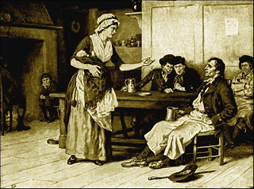
March 2017 – Words in Focus

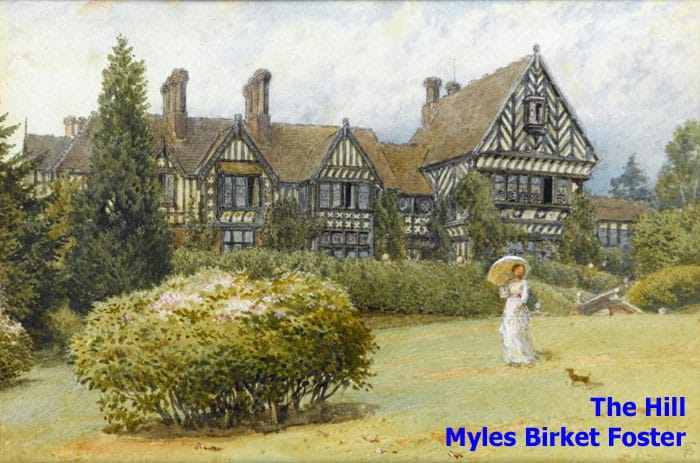
In the mid-nineteenth century, the area around Haslemere, Witley and Milford attracted a considerable number of London-based artists, drawn by the beauty of the landscape and the healthy air. The artist James Clarke Hook (1819-1907) moved to Hambledon in 1857 and was visited there by his friend Myles Birket Foster (1825-1899), one of the foremost watercolour painters of his time. Foster initially rented a summer cottage for his family and then in 1863 bought Wormley Hill where he built The Hill, a mock Tudor house decorated by William Morris. He was interested in the vernacular architecture of South West Surrey and he sketched and painted many of the local cottages and farmhouses. One cottage near his home in Wormley Wood was a favourite subject of many local artists, and Foster even paid for the roof to be repaired when it was threatened with demolition.

Another visitor to the area was Helen Allingham, well known for her paintings of Surrey cottages. She first visited the county when she and her husband stayed with their friend Lord Tennyson in Haslemere. In 1881 the couple bought a house in Sandhills, near Witley, and it was in the area that she discovered and painted the classic ‘chocolate box’ country cottages with their tumbling thatched roofs, cottage gardens and barefoot children in bonnets for which she is famed.

January 2013 – Surrey and the discovery of sunspots

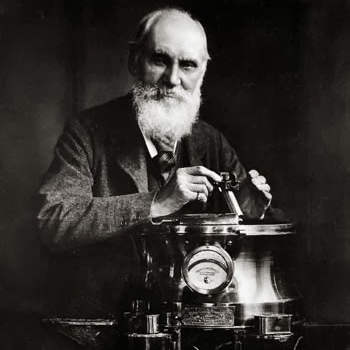
Redhill Observatory was built by Richard Carrington (1826-75) on Furze Hill in 1852, and it was here that he carried out the work that would lead his major contribution to the history of astronomy. He identified solar flares and devised a system for sequential numbering of complete rotations of the sun that is still in use today. 2,000 complete rotations were logged by 1995, continuing the system began by Carrington in November 1853, he noted a total of 99 rotations in his lifetime. These discoveries lead to the publication of:

•             A Catalogue of the 3753 circumpolar stars observed at Redhill in the years 1854, 1855, and 1856 (1857) (SHC Library 523.89 S1x)

•             Observations of the spots on the sun, from November 9, 1853, to March 24, 1861, made at Redhill (1863)

In the 1860s, after a few years away from Surrey, he purchased 19 acres of land in Churt where he built another house known as Jumps House and an observatory further up the hill at Middle Devil’s Jump. This involved tunnelling into the hill both vertically and horizontally; the altazimuth instrument was located in the vertical tunnel enabling it to be used without a dome. An engraving shows the observatory and house and is reproduced [on the website] from the Illustrated London News, Volume 59, 1871 (SHC Library J/572/51, J/572/48)

In 1869 Carrington married Rosa Helen Rodway, a marriage that was to embroil him in scandal which dominated the last few years of his life. A full account of this story together with an account of his importance to modern astronomy can be found in: The Sun Kings: the unexpected tragedy of Richard Carrington and the tale of how Modern Astronomy began by Stephen Clark (2007) (SHC Library 920CAR)

Coming out of Lockdown – a message from the Chairman

As lockdown begins to ease, I am delighted to be able to tell you that the Society Events Committee is beginning to plan events for August and beyond. As a Society, we are very fortunate in that many of our events are outdoors and I hope we will be able to provide some welcome relief from the isolation that we have all had to undergo.

At this stage we are limiting ourselves to a couple of garden visits and some walks.  We hope to be able to expand the programme during the Autumn.  We are having to keep our numbers small in order to ensure that there is adequate social distancing and online booking is essential so that we have an accurate record of attendees. I’m afraid we can’t do paper bookings because we aren’t able to get access to Warren Farm Barns, which is our postal address.

Unfortunately, we have had to cancel the Passionate about Glass event as Adam Aaronson is not opening his glass studio to the public for the foreseeable future.  Our treasurer will be organising refunds.

However I am delighted to say that the Society will be supporting Guildford Walkfest again this year in September. The Festival organisers were originally hoping to promote nearly 60 walks, but inevitably it is likely that the Festival will be considerably slimmed down this year. Events that the Society are leading will go up on the website shortly.

I would like to extend my thanks to our Trustees and the organising committees who have been so supportive during this very challenging time.  We do hope that all our members are well and we look forward to seeing you soon.

Gordon Jackson

Photo Competition Winner

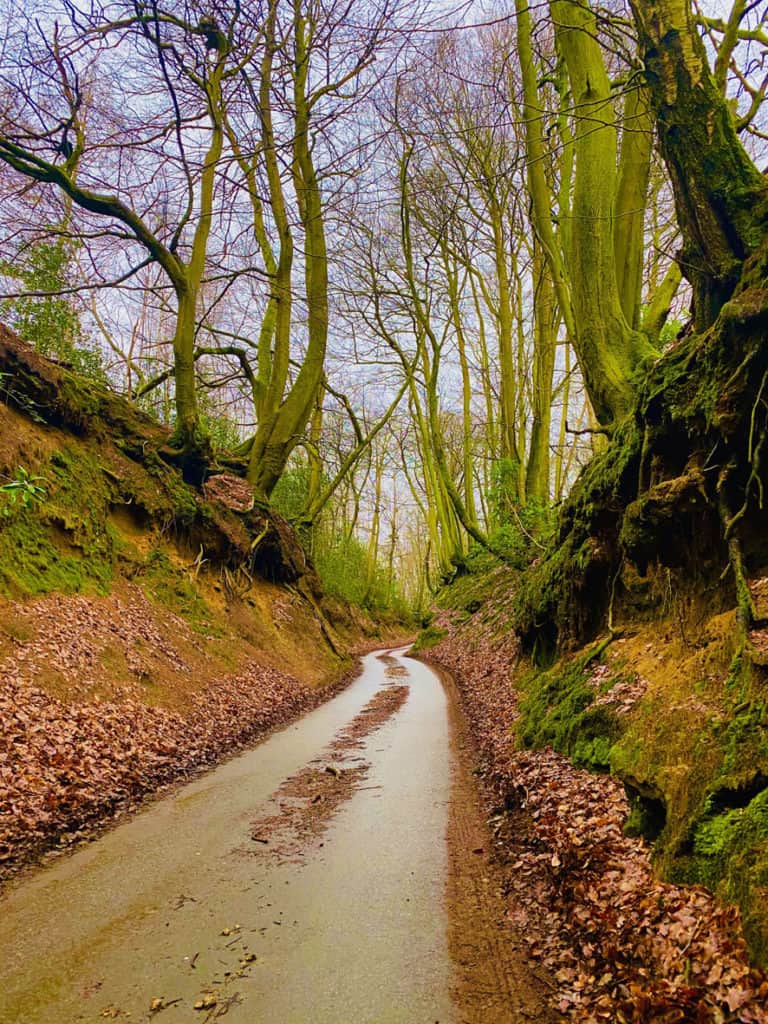
It is with great pleasure and after a great deal of discussion we have decided that the winner of our “What the Surrey Hills mean to you” Photographic Competition is….

Linda Norton’s

near Friday Street

Congratulations Linda. We will be in touch with you to arrange delivery of your prize of a bottle of wine from one of our Surrey Hills Wine Vineyards. Check out our five leading vineyards at https://www.surreyhillsvineyards.co.uk/

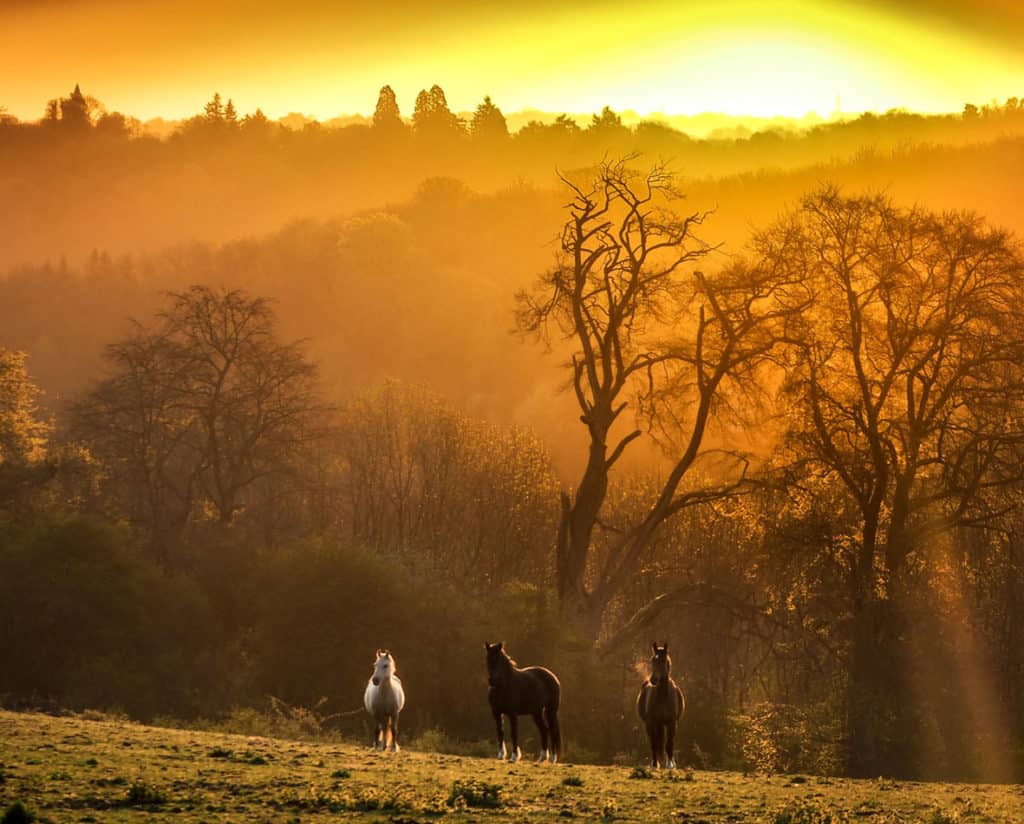
2nd place goes to Chris Tremain’s photograph taken near Chaldon

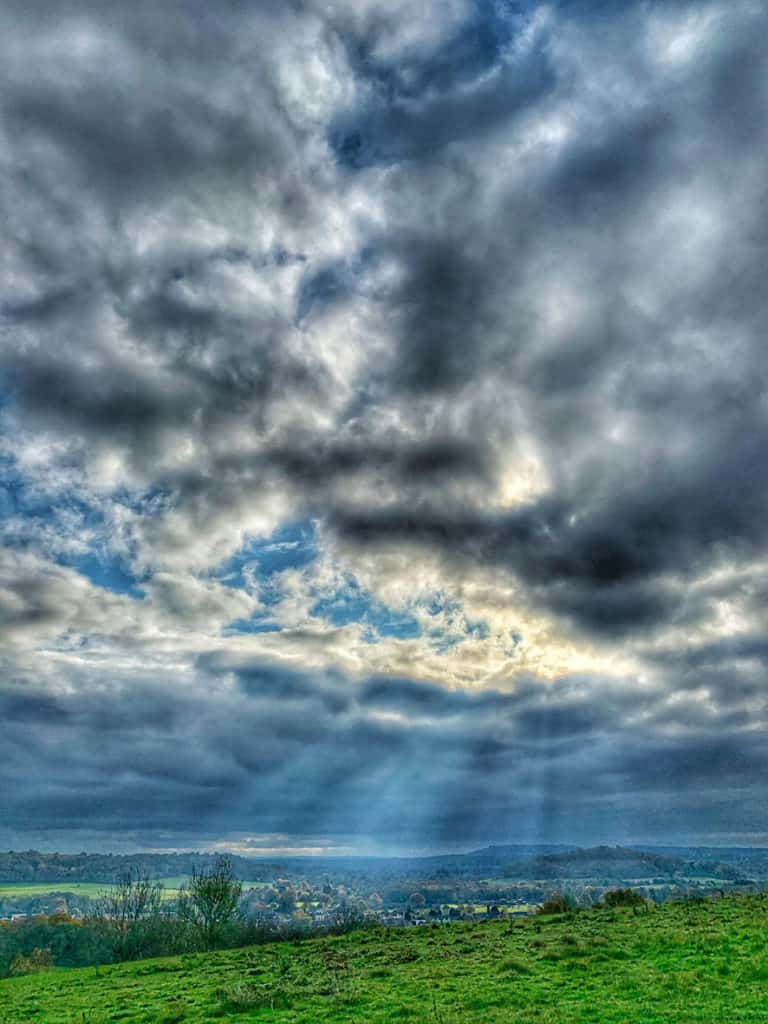
3rd place goes to Martin Ison with this photograph taken at The Chantries

Chris and Martin will each be receiving our runners up prize of a £5 discount voucher redeemable at any of our events which we hope to start in the not too distant future.

A huge thank you to everyone who entered, we hope you have enjoyed seeing these as much as we have and we look forward to seeing you all in the Surrey Hills again as soon as we are able.

Gordon Jackson, Ken Bare and Chris Howard

Virtual Visits

While we are probably all missing getting out and about in the Surrey Hills right now, we can still visit a diverse range of places as virtual escapism is just a click away.  From the comfort of your own home, cup of coffee in hand, or even a glass of wine, why not explore some old favourites or try out somewhere new.  Driving for pleasure may be forbidden and gardens, historic houses and galleries may all be closed right now, but we can still immerse ourselves in their beauty and often gain new insights and knowledge.  Susie Turner, from our Newsletter Team, gives us some examples of what is on offer.

The National Garden Scheme highlights several wonderful virtual garden tours on its website, among them Dunsborough Park, Ripley, mentioned in our chairman’s April e-mail as it was sadly one of our postponed visits.  The video is very uplifting so you may wish to take another look as it really is the ultimate tulip destination.  Or why not look at video clips of nearby Wisley, exploring perhaps the wisteria walk, the walled gardens, or mixed borders to give you new ideas for your own garden.

And if you are missing those gallery visits, you may enjoy taking a 360 degree tour of the Watts Gallery, or view the extensive art collection at Polesden Lacey, or perhaps take a quick peek at the Sculpture Park near Churt, with the option to purchase a piece of sculpture online.

Surrey Day’s virtual celebration, sponsored by BBC Radio Surrey, Surrey Life and Visit Surrey, on Saturday 2 May was a great success, so there is plenty to check out on the various websites. The Visit Surrey website in particular has many other suggestions, including lots of food and drink, – why not learn about a typical day at Albury Vineyard, family owned and using only organic grapes grown in the Surrey Hills.  Or what about something for all the family such as Spring at Bocketts’ Farm, the amazing British Wildlife Centre near Lingfield, or explore 16th century Loseley House and gardens, owned by Surrey’s Lord Lieutenant, Michael More-Molyneux.

Surrey Life also features a series of mini virtual tours of some of  Surrey prettiest places.  For those missing hiking further afield, why not navigate your path along the North Downs Way, starting at Farnham, and creating your own virtual trip.  And if it’s company you are after try following the Bald Explorer, Richard Vobes, as he walks and talks his way through local places of interest, including Reigate’s Fort and Priory Park or Leith Hill and the Greensand Way.

These are often short clips lasting just a few minutes, but they often offer something new to learn and give a real taster for a future visit.

While some virtual tours have been created specifically during lockdown, others are older, but nonetheless we feel they are still worth a look.

The latest from Surrey Hills Arts

Surrey Hills Society has worked closely with Surrey Hills Arts (SHA) for a number of years.  Much of their work relies on external grant funding and, understandably, the majority of these sources have been diverted towards the pandemic.  However, SHA haven’t been idle.  They have progressed a range of projects and are looking to initiate a fascinating piece of work that Society members may wish to participate in.

Recently, SHA have created an online programme of arts activities, many inspired by our landscape or using natural materials.  This weekly programme is allowing people of all ages to join the artist by simply clicking on the link and being instructed with their artworks.  So far they have painting for adults, wood carving and pyrography, print making and creating a papier mache friend to keep you company in this period of isolation!  These are all proving very popular and more classes are being added. The programme is also supporting our local artists who have suddenly found themselves without an income.

SHA have been developing a project on reviving historical crafts in the Surrey Hills.  The project will research into the history of these traditional crafts of the landscape.  It will identify and support specialists to train selected contemporary artists/makers who will then re-imagine the craft within the relevant landscape setting.  SHA hopes that the project will give access to a new audience who would not normally experience the crafts or landscape whilst providing new skills and knowledge.

The Surrey Hills have a strong history of making use of the natural materials of the land.  Basketry was a common industry in Guildford in the 18th century and hurdle making was widespread in South West Surrey.  Brickmaking has a long history in East Horsley using locally dug clay, white sand from Ockham Common and red sand from Ripley.

The first stage of this project is the research – so if any Society members have relevant knowledge or an interest in researching, please do get in touch at surreyhillsarts@gmail.com.  SHA are particularly interested in the crafts: basketry, brickmaking, hurdle making, pottery, textiles and glass.  They intend to do a pilot project in one area, possibly near Farnham as this is Surrey’s Craft Town.  To fund this project, SHA will be looking for sponsorship.  Naturally, if you know of anyone who would be interested in doing so, they would love to hear from you.

A Good Read

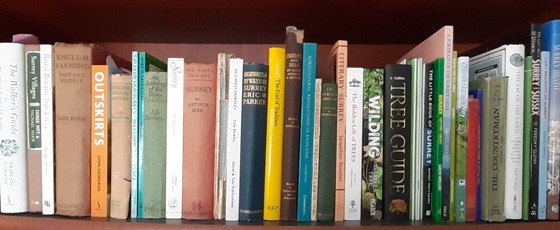
Both of the Society’s Vice-Presidents enjoy reading books about Surrey, the Surrey Hills and the surrounding area.  For this newsletter, they have each selected a book which they have enjoyed and which you might like to find for yourselves.  Ken has chosen a historical novel centred on Hindhead whilst Chris has selected a recent non-fiction book which gives some thought-provoking ideas about how we could enrich our countryside.  If you know of books that have a storyline based on and around recognisable locations within the Surrey Hills or relevant non-fiction books that make good reading, why not let us know at info@surreyhillssociety.org and we can create a book list on our website.

The Broom-Squire by Sabine Baring-Gould

Set in and around the Devils Punchbowl, this is a wonderful Victorian novel that deserves to have a wider modern readership.  It starts from the idea that the sailor who was murdered near Hindhead in 1786 had his baby daughter with him (his wife having just died in London).  Following the murder, the baby is found and brought up at a Thursley inn.  The story then does a “fast forward” of 18 years so that the baby is now a grown woman – naturally a very good looking one!

The woman has grown up with the son of the innkeeper but he leaves home after a family disagreement.  She falls into a hasty and ill-conceived marriage with the Broom-Squire.  He is one of a group of inter-related squatters who live in the bottom of the Punchbowl and dislikes (and is disliked by) everyone.

The core of the story is the interplay between the woman, the broom-squire and the inn-keepers son.  It may seem like the story-line for many Victorian romantic novels but there are all sorts of unexpected twists to the tale.

For a local reader, an added interest is that Baring-Gould was writing in the 1890s about an event which happened a century beforehand.  Thus his descriptive text contrasts Victorian landscape and life with that of an earlier period – both of which make a fascinating contrast to the area in modern times.

This book often pops up in antiquarian bookshops and is readily available (both as original and modern reprint) online via AbeBooks.co.uk or as a free download at Project Gutenberg.

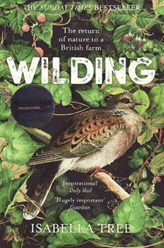
Wilding by Isabella Tree

Anyone with an interest in the management of the Surrey Hills landscape needs to read this book.  It challenges the assumption that ‘natural’ Britain was a closed canopy forest.  Many Surrey residents think we should just stop managing our woodlands and let them go back to primeval forest.  However, Isabella Tree expertly reveals why this version of our history is being challenged in re-wilding projects across Europe and more personally, at the Knepp Estate in West Sussex, owned by Isabella and her husband.

Like many of our struggling farmers, Isabella and her husband Charlie Burrell have been forced to question whether intensive farming is sustainable.  They decided to step back from all the EU farming grants and intensive farming techniques and just let nature take over.  By introducing free-roaming heritage cattle, ponies, pigs and deer – proxies for the large animals that once roamed Britain – the 3,500 acre project has seen extraordinary increases in wildlife numbers and diversity in little over a decade.  Their beef is now sought after by top London restaurants.  Chef, Heston Blumenthal claims it is even better than the famous Japanese wagyu beef.

The results have been astounding and challenge many of our commonly held beliefs about land and habitat management.  This includes assumptions about where rare birds such as nightingales and turtle doves, peregrine falcons and lesser spotted woodpeckers choose to live and breed and what the favourite haunts of rare butterflies are.

The book is beautifully written by this accomplished author and travel writer, who has also written The Living Goddess and The Bird Man.  Wilding has won several prizes and is a thoroughly recommended read for anyone interested in wildlife, farming or the environment.

A Surprise at St Catherine’s

If any of you have joined us on one of our walks along the North Downs Way heading out of Guildford along the banks of the River Wey, there is a good chance that we will have included a short diversion up to St Catherine’s Chapel.  This is not only a super viewpoint across the area but is also a historically interesting structure.  It has become even more interesting recently following a landslip which disrupted the adjacent railway line.

St Catherine’s Chapel, on top of the hill, was built in the early 14th century in the reign of Edward I.  An annual fair, also dating from the Middle Ages, was held every year until after the First World War.  But over the years evidence has been discovered of more distant human activity on the hill in the Iron Age, Bronze Age and even Mesolithic (middle Stone Age) periods.

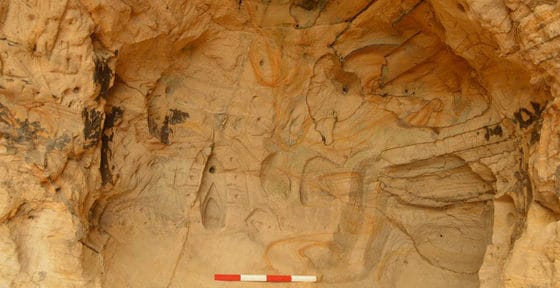
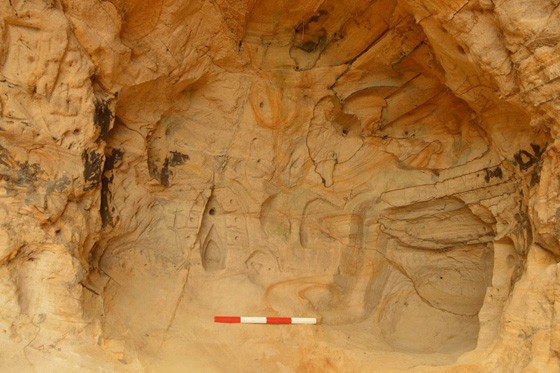
An incredible hidden cave thought to have been used as a medieval shrine has now been discovered in the hillside by rail workers repairing a recent landslip.  Network Rail engineers came across the small cave, with markings and evidence of use in the 14th century, while stabilising the embankment between the railway line and the A3100 Old Portsmouth Road.

The sandstone cave is made up of several sections ranging from 0.3 metres to about 0.7 metres high and it’s thought to be the surviving section of a much bigger cave.  The rest may have been lost when the railway line was carved out of the hillside in the early 1840s.

Images taken from the site show the presence of a Gothic niche decorated in dots with a Calvary cross nearby.  There are seven or eight further niches and experts found considerable evidence of writing and other markings across the cave ceiling.

The cave is partially covered in deposits of black dust, believed to be soot from lamps.  The remains of two suspected fire pits were also uncovered in the cave floor.  The hope is that radiocarbon dating can be used to establish the period when the cave was in use.

Mark Killick, Network Rail Wessex route director, said: “This is an unexpected and fascinating discovery that helps to visualise and understand the rich history of the area.  A full and detailed record of the cave has been made and every effort will be made to preserve elements where possible during the regrading of the delicate and vulnerable sandstone cutting.”

Tony Howe, historic environment planning manager and county archaeologist at Surrey County Council, added: “The discovery of this cavern is tremendously exciting.  It’s very early in the process of understanding its full significance, but the potential for knowledge acquisition is huge.  We’re looking forward to learning an awful lot more about the site as studies progress.”

What has the Society been doing?

You will be aware that one of the effects of the coronavirus lockdown has been the cancellation of our current events programme.  This is probably the aspect of our work seen by most of our members.  However, the Society hasn’t just pulled up the drawbridge and ceased to function.  There has been a large amount of work continuing in the background.  In the following sections we can give you an indication of some of the key topics and, in doing so, help to show how wide our range of activities has become.

AONB Management Plan

Late in 2019, the AONB Board launched the latest version of the Surrey Hills AONB Management Plan which covers the period 2020 – 2025.  Having got the strategic document agreed by all the Borough & District councils and Surrey County Council – who contribute financially to the AONB and who are required by law to implement the plan – the next stage has been to agree who is going to deliver specific activities in order to achieve the required objectives and targets.  Each objective has a lead organisation plus a number of supporting ones.  In most cases, the lead body is one of the components of the AONB ‘family’ of Board & Management Team, Society, Enterprises or Trust Fund and in many instances, the work is supported by multiple ‘family’ members.

For the Society, the biggest topic area is around communication and awareness.  This is very much our forte since we have come to be known as a public face of the Surrey Hills AONB.  Our newsletters, presence at shows and fetes, external talks and media exposure all contribute to this.  And this is also where our Events programme fits in because the more people we can get out into the area the more they learn about it and hence become ambassadors themselves.

To make all this happen, our Chairman and Vice-Presidents have been working with the AONB Board and Management to develop a detailed Delivery & Monitoring Plan which will be reviewed quarterly by the Board to track progress.  Coronavirus may have disrupted a lot of things but the clock is still ticking and hence the Society has been working away in the background to ensure that it can deliver on its commitments.

The Society’s Annual Review

Our members have recently received an email to let them know that the Society’s Annual review for 2019-2020 has been written and published.  This is the third year that we have produced a look back at the year’s activities and it has proved to be a useful record and promotional tool.  On this occasion we took the decision to issue it as soon as possible after our year end rather than wait for our AGM in the autumn.

This type of document involves input from a large number of our volunteers.  Quite apart from writing the text and providing the photos (Ken Bare), data and content was provided by our Chairman (Gordon Jackson), Finance Director (Martin Cantor), Membership Secretary (Stella Cantor) and Vice-President (Chris Howard).  One of our members (Piers Plummer) turned it all into the professional looking document that we issued and we relied strongly on the eagle eyes of our proof readers (Susie Turner, Sall Baring, Lesley Crofts and Diane Cooper).  We are incredibly grateful to all of them for the hours of work that they contributed to making this happen.

Surrey Hills Photo Competition

By the time that you receive this e-newsletter, our photo competition will have just closed.  A good number of you have submitted photos which have been placed on our website.  The Chairman and Vice-Presidents now have the tricky task of judging the entries to identify a winner.  This is certainly not the easiest of tasks since there are some stunning images.

Social Media

In parallel with our photo competition, we have been expanding our presence on social media including Facebook, Twitter and Instagram where a number of our active members have been submitting images.  We are in the early days of developing these lines of communication but they are already showing success in helping us to reach new audiences.

As a reminder:

Events Planning

Whilst our current programme of events may have gone on hold, we want to be able to hit the ground running when the right time comes.  Many of the events organised by the Society have a long lead time – up to a year in some cases!  To enable us to give our members a programme to look forward to, our Events Team have been working away in the background.  Hopefully we will be able to revive some of the visits which were planned for 2020 and include them in our 2021 schedule.  Meanwhile, other topics come to light or opportunities arise and our Team is always on the lookout for these.

One specific element of our events programme which has become very popular is our involvement with local walking festivals.  We had planned to participate in Farnham Walkfest in May, a new event planned for the Dorking area and, of course, our major involvement with Guildford Walking Festival in September.  At the moment, it is unclear whether Guildford Walking Festival will be able to go ahead but we are continuing to work as if it will – even if it’s in a modified form.  The Society normally hosts numerous walks during this month long festival – and also provides several of the core organising team – so a significant amount of work is involved.